Earlier this year, work required me to make a trip to Bundi, and as circumstances would have it, I had to return the same day. A day trip to Bundi is definitely not something I would recommend. It is exhausting and leaves little time to truly absorb the rhythm of the city.
A former princely state, Bundi’s decline began with the separation of Kota, yet it still carries traces of that old grandeur and natural charm that once drew writers and wanderers alike. Rudyard Kipling spent two years here, inspired to write Kim. In his Letters to the Marque, he described the palace of Bundi with words that still ring true:
“Jeypore Palace may be called the Versailles of India; Udaipur’s House of State is dwarfed by the hills round it and the spread of the Pichola Lake; Jodhpur’s House of Strife, grey towers on red rock, is the work of giants, but the Palace of Boondi, even in broad daylight, is such a Palace as men build for themselves in uneasy dreams—the work of goblins rather than of men.”
– Rudyard Kipling, Letters to the Marque
The Taragarh Fort and Garh Palace rise steeply from the hillside, adding to that same sense of wonder Kipling captured so vividly.
Sukh Mahal
Before heading to the palace, I stopped briefly at the Sukh Mahal, a summer retreat of the Bundi rulers and the place where Kipling stayed while writing Kim. Overlooking the still waters of the Jait Sagar Lake, it is easy to imagine why inspiration found him here. The site also houses a small museum displaying weaponry, miniature paintings from the Bundi and Kota schools, and an open-air collection of stone sculptures. Much like the rest of Bundi, it holds immense potential if developed and conserved with care.


Garh Palace & Chitrashala
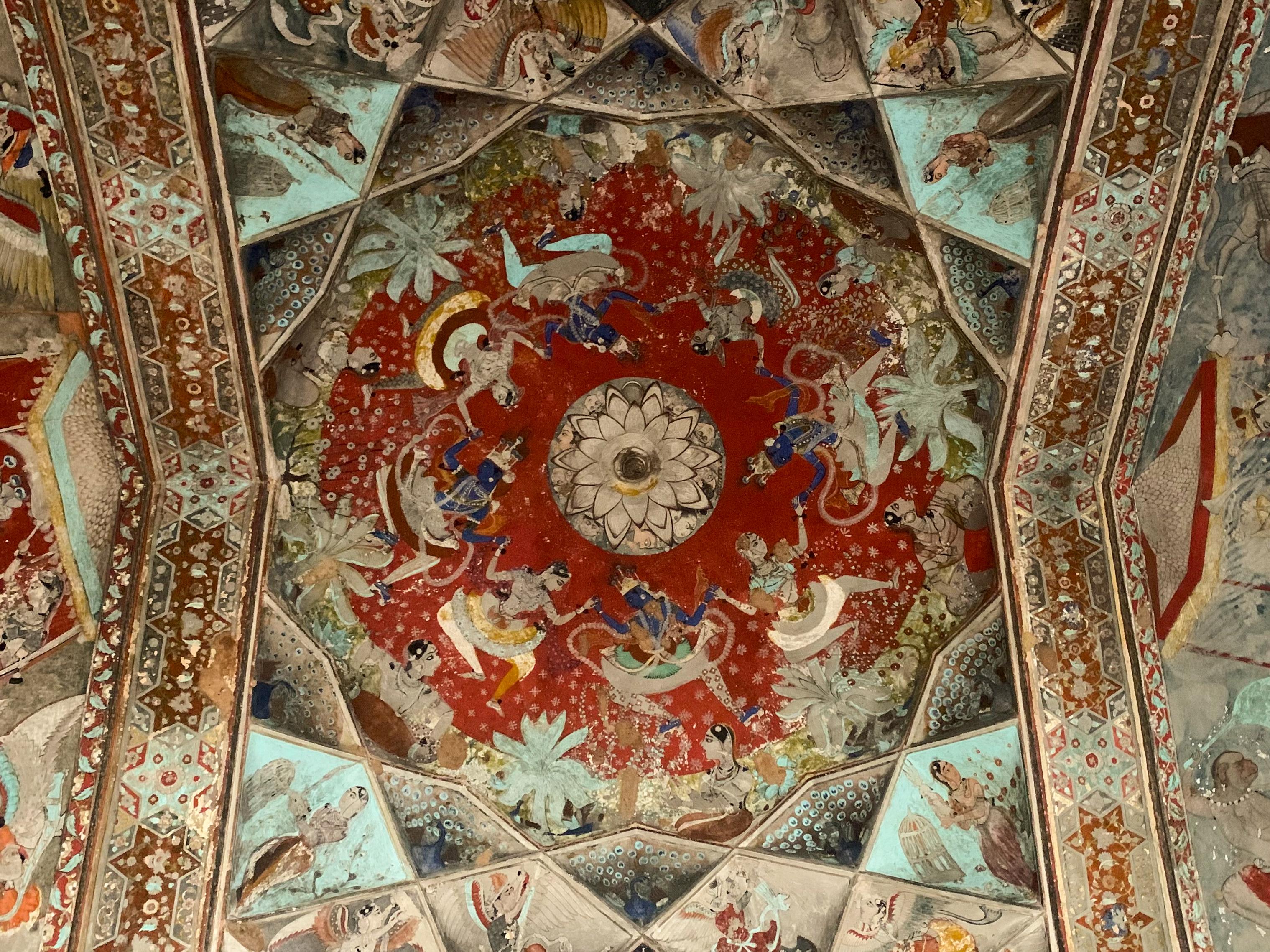
I still remember the quiet awe that settled over me the first time I stepped into the painted halls of Garh Palace in Bundi. The walls were alive with every surface telling a story. There were scenes of gods and lovers, of royal processions and fleeting monsoon clouds, all rendered in that unmistakable Bundi style. Graceful figures outlined in fine lines, the softest blues, the deepest reds and golds dancing in the filtered light. The murals radiated a quiet majesty as I wandered through the near-empty halls. I remember tracing my eyes over the cracks and missing fragments, feeling both wonder and a deep ache that something so exquisite could be so fragile, so close to disappearing..


When I recently came across an Architectural Digest article announcing that these very paintings will soon be conserved, it stirred something within me. As a conservation architect, this news carries a deep resonance. It is more than a project or a technical effort; it is an act of care and continuity. These murals are not just art; they are records of a worldview, of craftsmanship and devotion that defined an era. Knowing that they will be studied, understood, and restored with sensitivity gives me hope for what conservation can achieve when guided by empathy and respect for context. It reminds me why I chose this profession, to bridge the delicate space between memory and renewal, to ensure that stories like Bundi’s are not lost to neglect or haste.
And yet, as much as the palace stirs admiration, it also throws into sharp relief the condition of the town that surrounds it. Bundi’s lanes, stepwells, and havelis, each carrying the same quiet poetry, are in urgent need of thoughtful urban renewal. The city holds an extraordinary architectural legacy, but time and indifference have frayed its fabric and overwhelmed its narrow lanes. Just as importantly, the people of Bundi, who live amidst this heritage need to be at the heart of any effort to revive it. True renewal must respond to their everyday realities with better infrastructure, opportunities for livelihoods and spaces that improve quality of life while celebrating their identity. I can only hope that this renewed interest in Garh Palace will become a spark for something larger and that one day, Bundi itself will receive the care it deserves through a sensitive reawakening that honours its past while making space for its future.


If You Go to Bundi
Give yourself at least two full days in Bundi. The city lies about four hours from Jaipur, and can also be reached easily by train via Kota. Stay within the old city in one of the many charming homestays so you can explore on foot and experience its unhurried pace. Apart from Garh Palace and Sukh Mahal, don’t miss the exquisite stepwells such as Raniji ki Baori, Dabhai Kund, and Nagar Sagar Kund, or the painted havelis tucked into the old quarters. Take time to wander through the narrow streets and watch life unfold at its own rhythm. For a sweeping view of the city, climb up to Taragarh Fort; the vistas are said to be especially beautiful at sunset during the winter months.
As I boarded my train back, Bundi continued to linger in my mind with the hope that perhaps one day, through careful conservation and sensitive renewal, Bundi will reclaim the place it deserves among India’s living heritage cities.